
 Traceability
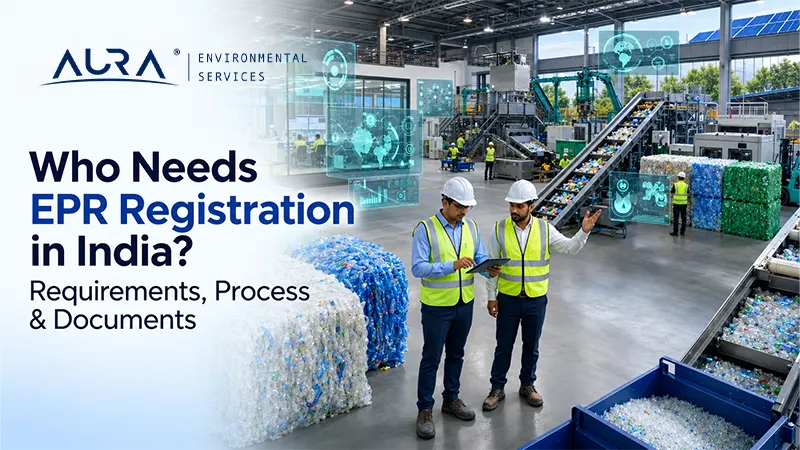
Who Needs EPR Registration in India? Requirements, Process & Documents
Key Takeaways
- EPR Registration in India is essential for producers, importers, and brand owners managing regulated products and waste streams.
- Accurate category mapping is crucial to comply with specific EPR obligations related to various waste streams.
- Businesses must compile necessary documents like GST, PAN, and product details before EPR Registration in India.
- Post-registration, companies need to manage ongoing compliance by tracking targets, certificates, and returns.
- EPR Registration in India is necessary for producers, importers, and brand owners of regulated products.
Aura Environmental Services Pvt. Ltd., a leading provider of EPR registration and environmental compliance services, supports businesses with registration, documentation, portal filing and ongoing EPR requirements. For producers, importers and brand owners dealing with regulated products or waste streams, understanding EPR Registration in India is important before starting or expanding market activities.
EPR requirements vary according to the product, business role and applicable waste category. Correctly identifying these factors is the first step toward proper compliance.
What Is EPR Registration?
Extended Producer Responsibility, commonly known as EPR, places defined end-of-life responsibilities on businesses that introduce specified products or materials into the market.
Registration is generally completed through the relevant Central Pollution Control Board portal for the applicable waste stream. The business must identify its category, provide required information and documents, and meet the compliance requirements connected with that category.
EPR is not limited to registration alone. Depending on the applicable framework, businesses may also have responsibilities related to targets, returns, recycling certificates, records and ongoing portal compliance.
Who May Need EPR Registration?
The requirement depends on the type of product or material placed on the Indian market. EPR Registration in India can apply to different business categories depending on the specific waste-management framework.
Common obligated entities may include:
- Producers and manufacturers
- Importers of covered products or materials
- Brand owners placing packaged or branded goods in the market
- Businesses selling applicable products under their own brand
- Entities importing specified products for domestic sale
- Certain recyclers or processors where registration is required under the relevant waste stream
For plastic packaging, the commonly used term PIBO refers to Producer, Importer and Brand Owner. For other waste streams, the definitions and obligated categories can differ, so businesses should assess their exact activity before applying.
Which Waste Streams Are Covered?
The current Aura EPR service covers several major waste categories managed through applicable EPR frameworks.
These include:
- Plastic waste
- Battery waste
- E-waste
- Tyre waste
- Used oil
- Construction and demolition waste
- Scrap of non-ferrous metals
For example, battery producers are required to register through the CPCB’s centralised system under the applicable battery waste framework. CPCB documentation also describes EPR obligations linked to recycling or refurbishment targets for batteries placed in the market.
Because requirements differ across categories, businesses should not assume that a registration completed for one waste stream automatically covers another.
Key Requirements Before Applying
Businesses planning EPR Registration in India should first establish exactly what they manufacture, import, sell or brand and under which category those activities fall.
A practical pre-registration check should cover:
- Your legal business structure and registration details
- Whether you operate as a producer, importer, brand owner or another applicable category
- The product or waste stream covered by your activity
- Quantities placed on the market, where applicable
- Product or packaging categories
- Previous sales or import data where required
- Applicable recycling or EPR obligations
- Details needed for CPCB portal registration
Getting the category mapping right is particularly important because EPR obligations are linked to the nature and quantity of products or materials introduced into the market.
Documents Commonly Required for EPR Registration
The exact documents depend on the applicable waste stream and business category. However, companies should normally be prepared with core legal, business and product-related records.
Typical documentation may include:
- Company incorporation or registration details
- GST details
- PAN and other business identification documents
- Authorised signatory information
- Product or material details
- Import, production or sales information where applicable
- Brand and packaging information
- Category-wise quantity data
- Supporting declarations or portal-specific documents
For battery registration, CPCB’s published process specifically includes general producer information, battery type, sales data, battery material information, required document uploads and payment of the applicable registration fee.
EPR Registration Process
Although individual portals may differ, the overall compliance process usually follows a structured sequence.
- Assess applicability: Identify the business role, applicable product and relevant waste stream.
- Map the category: Classify products, packaging or materials according to the applicable framework.
- Compile documents: Gather corporate, product, quantity and supporting records.
- Submit the application: Complete registration through the relevant CPCB EPR portal.
- Respond to queries: Provide clarifications or additional documentation where requested by the authority.
- Manage ongoing compliance: Track applicable targets, certificates, returns and portal obligations after registration.
Aura Environmental Services Pvt. Ltd. currently provides end-to-end support covering obligation assessment, registration, target fulfilment and return filing.
What Happens After Registration?
Obtaining the registration certificate is not necessarily the end of the EPR process. Businesses may need to maintain data, fulfil assigned obligations and submit applicable annual or quarterly returns.
For some waste streams, EPR certificates generated through registered recyclers are used toward meeting recycling obligations. CPCB has also been developing electronic systems for the exchange or transfer of EPR certificates across applicable waste categories.
This makes ongoing record management as important as the initial application.
Why Choose Us
At Aura Environmental Services Pvt. Ltd., we help producers, importers and brand owners manage EPR Registration in India through a structured compliance process. Our support includes obligation assessment, category mapping, document preparation, CPCB portal registration, target fulfilment support, recycler coordination and applicable returns. With pan-India EPR services, our team helps businesses understand which waste stream applies to their operations and what information is required for registration and ongoing compliance.
Conclusion
EPR registration requirements depend on what a business manufactures, imports, sells or introduces into the Indian market. Plastic packaging, batteries, electrical and electronic equipment, tyres, oils and other covered waste streams can have different definitions, obligations and portal requirements. Businesses should therefore identify their category, prepare accurate quantity and product data, and complete the relevant registration before managing ongoing targets and returns. Aura Environmental Services Pvt. Ltd. supports businesses with EPR Registration in India, documentation, portal handling and continued EPR compliance assistance.
Need help identifying whether EPR applies to your business? Contact Aura Environmental Services Pvt. Ltd. for professional support with EPR applicability assessment, registration, documentation and ongoing compliance.
Call: +91 76219 49043
Or Email: management@auraenv.com
Contact our team today to start your EPR registration process with clear, structured compliance support.
FAQs
EPR registration in India is required for producers, importers, brand owners, and certain recyclers handling regulated products or waste streams. Each business must assess its activities and the corresponding waste framework to determine if registration is necessary.
Typically, businesses need to prepare documents such as company registration details, GST and PAN information, product details, sales or import records, and packaging information specific to their waste stream. The exact documents can vary based on the applicable waste category.
The EPR registration process generally involves identifying applicability, mapping categories, compiling required documents, submitting the application through the CPCB EPR portal, and responding to any inquiries from the authority. Continuous compliance management is also necessary after obtaining registration.
EPR registration in India covers several major waste streams, including plastic waste, battery waste, e-waste, tyre waste, used oil, and construction and demolition waste. Each type has distinct obligations and requirements.
After completing EPR registration, businesses must maintain compliance by tracking targets, submitting returns, and managing documentation. Ongoing obligations may include fulfilling recycling targets and maintaining communication with registered recyclers.
Need to measure particulate matter at your site or boundary? Aura’s NABL lab monitors ambient and stack air to CPCB norms. Explore air testing.
Keep reading
More insights
Traceability Compliance
 Service