Residual Solvent Analysis
Residual organic solvents in APIs, intermediates, formulations and products — by Headspace GC against product and ICH-class limits.

GC & solvent analysis at a glance
Gas-chromatography analysis of solvents and volatile organics — residual solvents, VOCs, BTEX and solvent purity — determined by GC-FID, GC-MS and Headspace GC for pharma, chemical, dye and paint industries across Gujarat.
Aura Environmental Services Pvt. Ltd. runs gas chromatography (GC) in its NABL-accredited laboratory in Odhav, Ahmedabad. We separate, identify and quantify volatile and semi-volatile organic compounds — residual solvents in products and intermediates, VOCs in ambient and work-zone air, BTEX in water and effluent, and the purity of recovered solvents — using GC-FID, GC-MS and Headspace GC to ISO/IEC 17025 methods for product quality, workplace safety and GPCB/CPCB compliance.
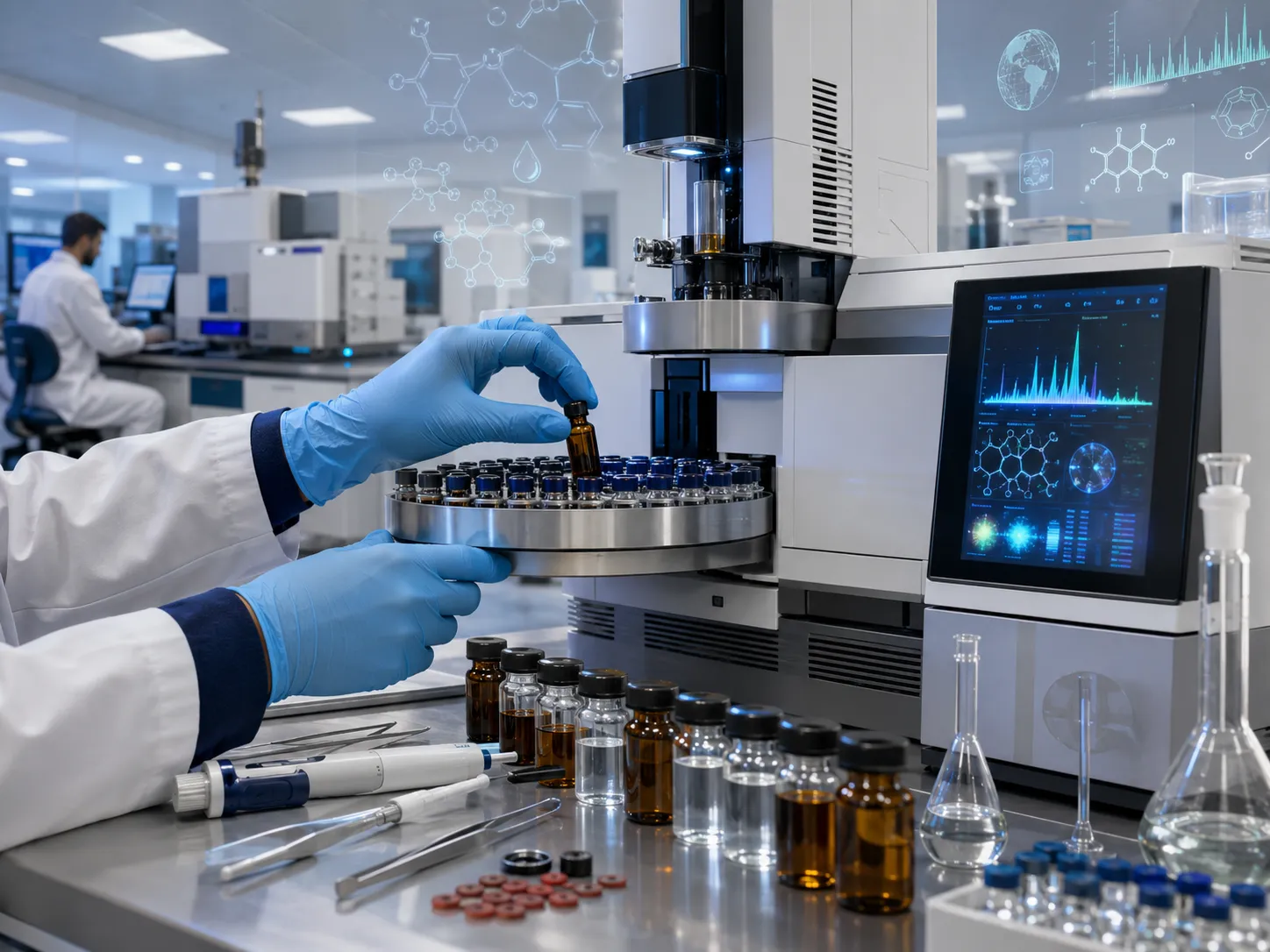
From residual solvents in a product to VOCs in the air your team breathes.
Residual organic solvents in APIs, intermediates, formulations and products — by Headspace GC against product and ICH-class limits.
Volatile organic compounds and solvent vapours in ambient and work-zone air for GPCB norms and occupational exposure.
Benzene, toluene, ethylbenzene and xylene in water, groundwater and industrial effluent as priority pollutants.
Unknown-solvent identification by GC-MS and purity assay of raw or recovered solvents.
Composition and purity of distillate from solvent-recovery systems to verify recovery performance.
Organic-content and calorific characterisation of spent solvents for compliant disposal or co-processing.
A representative range across pharma, chemical, dye and coating processes — determined by GC-FID and confirmed by GC-MS.
Tell us your matrix and target compounds and we’ll set up the right GC method.
Request a test planA clear, accountable process — so you always know what happens next.
Tell us the matrix, target solvents and purpose. We define the method and sampling plan.
We collect product, air (sorbent tubes), water or spent-solvent samples with proper chain-of-custody.
Samples are run on GC-FID, GC-MS or Headspace GC to ISO/IEC 17025 methods with full QA/QC.
You receive a clear, statutory-ready report — accepted for quality, safety and GPCB compliance.
The sectors we sample, test and keep compliant across Gujarat.
Not listed? We work across manufacturing, institutions and infrastructure.
See all industriesCharacterisation, TCLP leachate and calorific value — including spent solvents.
Learn moreAmbient, work-zone and stack monitoring — PM, gases and VOCs.
Learn moreDrinking, borewell, effluent & STP/ETP water analysis to IS 10500 and GPCB norms.
Learn moreTell us the sample, parameters and deadline — our team replies with a sampling plan, timeline and quote, usually within one working day.

We've received your request. Our team will reach out shortly.
Ask about NABL-accredited testing for water, air, soil, noise or hazardous waste.
We usually reply within minutes during business hours.
Get help with GPCB consent (CTE/CTO), EPR registration or environmental audits.
We usually reply within minutes during business hours.
Have a general question? Message our team directly.
We usually reply within minutes during business hours.