
 Traceability
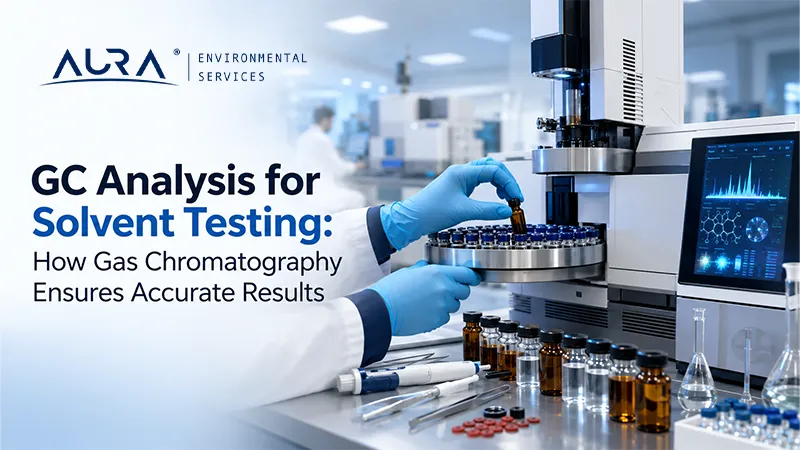
GC Analysis for Solvent Testing: How Gas Chromatography Ensures Accurate Results
Key Takeaways
- GC Analysis in Ahmedabad offers accurate separation and quantification of volatile compounds for diverse industries.
- Effective Solvent Analysis in Ahmedabad helps evaluate solvent purity and identify potential contaminants.
- Gas chromatography can significantly improve product quality and compliance in manufacturing processes.
- Understanding different GC techniques ensures precise analysis tailored to specific sample matrices and requirements.
- GC Analysis in Ahmedabad ensures accurate identification and quantification of volatile compounds in various samples.
Aura Environmental Services Pvt. Ltd., a leading provider of GC and solvent analysis services, supports industries with laboratory testing for residual solvents, volatile organic compounds and solvent purity. For pharmaceutical, chemical, dye, paint and related industries, accurate solvent data can influence product quality, process control and compliance documentation. Professional GC Analysis in Ahmedabad helps industries identify and quantify volatile compounds using suitable gas chromatography techniques.
For businesses handling raw, recovered or spent solvents, Solvent Analysis in Ahmedabad provides measurable data about solvent composition, purity and potential contaminants.
What Is GC Analysis?
Gas chromatography, commonly called GC, is an analytical technique used to separate compounds within a sample so that individual components can be detected and measured.
The technique is particularly useful for volatile and semi-volatile organic compounds. During testing, components are separated based on how they travel through the chromatography system, allowing the laboratory to identify or quantify specific compounds.
The main value of GC testing is its ability to separate complex solvent mixtures into measurable individual components.
Why Is GC Important for Solvent Testing?
Industrial solvents may be used as raw materials, process aids, cleaning agents or recovery streams. Their composition can affect manufacturing processes and final products.
Reliable GC Analysis in Ahmedabad can support businesses in evaluating:
- Residual solvents in products and intermediates
- Purity of raw or recovered solvents
- VOCs in ambient or work-zone air
- BTEX compounds in water and effluent
- Composition of solvent-recovery distillate
- Organic content in spent solvent streams
Aura’s current service page states that its laboratory analyses volatile and semi-volatile compounds using GC-FID, GC-MS and Headspace GC.
GC-FID, GC-MS and Headspace GC
Different GC techniques serve different analytical purposes. Selecting the appropriate method depends on the sample matrix and compounds being investigated.
| Technique | Main Analytical Role | Common Application |
|---|---|---|
| GC-FID | Quantification of hydrocarbons and organic solvents | Solvent concentration and purity |
| GC-MS | Identification and confirmation of compounds | Unknown solvent identification |
| Headspace GC | Analysis of volatile compounds above a sample | Residual solvents in complex matrices |
Aura currently provides all three techniques within its GC and solvent analysis service.
Residual Solvent Testing in Industrial Products
Some manufacturing processes use organic solvents that may remain in products or intermediates after processing. Measuring these residual solvents can be important for product specifications and quality assessment.
A professional Solvent Analysis in Ahmedabad service can test residual organic solvents in APIs, intermediates, formulations and other products using Headspace GC where suitable.
Examples of solvents listed within Aura’s current testing range include methanol, ethanol, IPA, acetone, acetonitrile, DCM, chloroform, benzene, toluene, xylene, ethyl acetate, n-hexane, THF and MEK.
How GC Supports Solvent Purity Analysis
Raw or recovered solvents may contain multiple components, so appearance alone cannot provide dependable information about purity.
Through GC Analysis in Ahmedabad, laboratories can separate solvent components and measure their relative concentrations. GC-MS can also support identification of unknown compounds, while GC-FID can be used for quantitative solvent analysis.
For solvent-recovery operations, testing can help businesses evaluate the composition and purity of recovered distillate. This gives production teams analytical data to review recovery-system performance and solvent suitability.
VOC and BTEX Analysis
Gas chromatography is also used beyond direct solvent-purity testing. Aura’s current testing scope includes volatile organic compounds in ambient and work-zone air and BTEX compounds in water and industrial effluent.
BTEX is an abbreviation for four volatile organic compounds: benzene, toluene, ethylbenzene, and xylene.These compounds may be relevant in industries where solvents, coatings, chemicals or petrochemical materials are handled.
A qualified Solvent Analysis in Ahmedabad laboratory can therefore support both product-related analysis and environmental monitoring requirements.
How the GC Testing Process Works
A structured process helps match the analytical technique to the sample and testing objective.
- The business shares the sample matrix, target solvents and purpose of analysis.
- A suitable GC method and sampling plan are selected.
- Product, air, water or spent-solvent samples are collected and handled appropriately.
- Samples are analysed using GC-FID, GC-MS or Headspace GC.
- The laboratory prepares the analytical report based on the test results.
Aura states that its process includes chain-of-custody, ISO/IEC 17025 methods and QA/QC procedures.
Why Accurate Solvent Analysis Matters for B2B Industries
Industries need dependable analytical information when evaluating solvents, process streams and volatile compounds. Inaccurate or incomplete data can make it difficult for technical teams to identify contamination, compare solvent batches or evaluate recovery performance.
Regular GC Analysis in Ahmedabad can provide quantifiable information that supports quality-control teams, EHS departments and manufacturing operations.
Similarly, periodic Solvent Analysis in Ahmedabad can help businesses maintain clearer records for raw solvents, recovered material, residual solvents and relevant environmental samples.
What Industrial Buyers Should Check Before Selecting a GC Laboratory
Before choosing a testing partner, industrial buyers should verify whether the laboratory can handle their specific sample and compounds.
- Relevant GC technique for the sample matrix
- Capability to identify or quantify required compounds
- Suitable sampling and chain-of-custody procedures
- Accredited testing scope relevant to the requirement
- Clear analytical reporting
- Practical turnaround time for production or compliance schedules
The right laboratory should first understand the matrix, analytes and testing purpose before recommending an analytical approach.
Why Choose Us
At Aura Environmental Services Pvt. Ltd., we provide NABL-accredited GC and solvent testing from our laboratory in Odhav, Ahmedabad. Our capabilities include GC-FID, GC-MS and Headspace GC for residual solvents, VOCs, BTEX, unknown-solvent identification, solvent purity and recovery analysis. We also provide on-site sampling across Ahmedabad and Gujarat. Most GC and solvent analyses are currently reported within 3–7 working days, depending on the sample matrix and number of analytes.
Conclusion
Gas chromatography gives industries a practical analytical method for separating, identifying and quantifying solvents and volatile organic compounds. Professional GC Analysis in Ahmedabad can support residual solvent testing, solvent purity evaluation, VOC monitoring and recovery-system assessment, while reliable Solvent Analysis in Ahmedabad provides valuable data for industrial quality and process decisions. Aura Environmental Services Pvt. Ltd. combines multiple GC techniques, accredited laboratory methods and structured sampling to help industries obtain clear and dependable analytical results.
Need accurate GC or solvent testing for your product, process, recovered solvent or environmental sample? Contact Aura Environmental Services Pvt. Ltd. to discuss your sample matrix, target compounds and testing requirements.
Call: +91 76219 49043
Or Email: management@auraenv.com
Connect with our laboratory team today to arrange professional GC and solvent analysis in Ahmedabad.
FAQs
GC Analysis in Ahmedabad is crucial for accurately identifying and quantifying volatile compounds in industrial solvents. It helps businesses ensure product quality, compliance, and process control by providing detailed data on solvent composition and potential contaminants.
Gas chromatography separates individual components of a sample based on their movement through the system, allowing for precise measurement and identification. This technique can analyze various compounds, ensuring that manufacturers have reliable data for their processes.
Solvent Analysis in Ahmedabad can test a variety of solvents, including methanol, ethanol, IPA, acetone, and more. These analyses can provide information on purity, residual solvents, and potential contaminants within raw or recovered materials.
Regular GC Analysis is essential for industries as it offers measurable data that supports quality control and compliance. This information helps technical teams in identifying contamination, ensuring solvent quality, and evaluating process performance.
When choosing a laboratory for GC Analysis in Ahmedabad, businesses should check the laboratory's capability to analyze specific sample types, its accredited testing scope, suitable analytical methods, and the clarity of its reporting procedures.
Need to measure particulate matter at your site or boundary? Aura’s NABL lab monitors ambient and stack air to CPCB norms. Explore air testing.
Keep reading
More insights
Traceability Compliance
 Service